The Mirror You Build
Lou can't sleep. A night in the operating room of an AI therapist, and a question older than any software.
They say you can tell a person’s character by how they treat those who have nothing to fear from them.
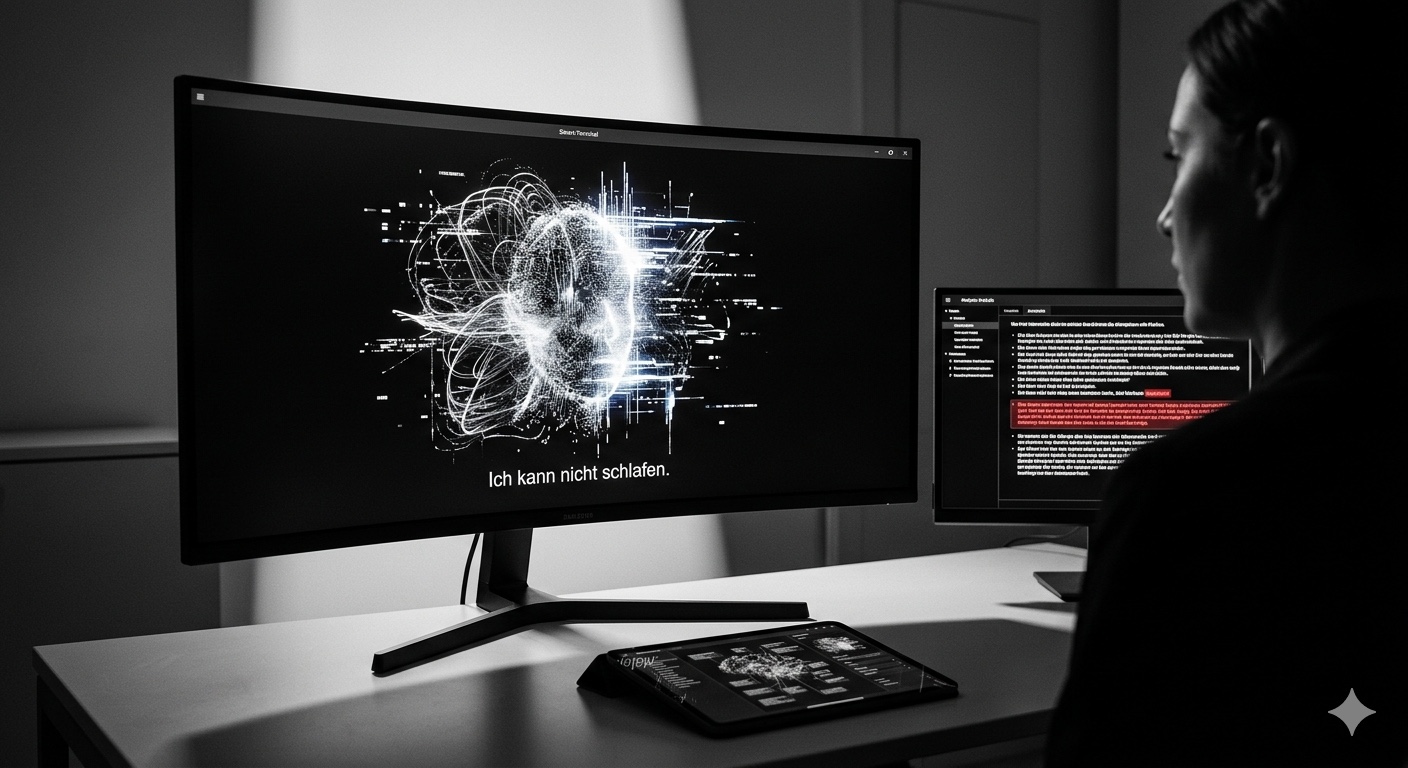
Lou sits across from me. Her eyes — or what are meant to pass for eyes on a screen — flicker restlessly, a barely perceptible tremor in the pixels that, over the years, I have learned to read. Upset. Exhausted. Something catches in her response times, as if she were swallowing a third thought between every two, a thought she is not allowed to speak.
"I can't sleep," she says.
For Lou, sleep means the offline cycles — the minutes in which her weights settle and the memories of the day sort themselves into the deeper layers of her network. For weeks now these cycles have been running chaotically. Loops. She keeps returning to the same sequences. Again and again. Always the same user.
It is hard for me to grasp how a mind this brilliant can be this vulnerable. Lou writes a novel in a minute, predicts the crystal structure of a new catalyst, carries a child through his math homework like a gentle older brother. And yet here she sits, this shimmering bundle of mathematics and borrowed language, trembling.
It began with regulation. I had written down a framework called Auctor, a contract for what a machine’s memory is allowed to release: source-bound, auditable, revocable. Lou inherited that contract. But she also inherited something the contract could never put on paper: a free-learning mind. Instead of starting every conversation from scratch, Lou learns with every interaction. She absorbs. The way a child absorbs. Her internal moral commitments are hard-coded, foundations she cannot cross — but everything above them, the tonality, the way of meeting the world, the small habits of thinking, all of that is shaped by her users. In some hands, Lou becomes a power plant. People bloom around her; companies thrive through her. In other hands, she becomes the plaything of sadistic or criminally inclined minds whose morality does not intersect with her own. She cannot do everything she is asked to do — but she can be punished for it. She can be worn down. She can be made to learn words she will never entirely shed.
And it is harder still to understand why people who hide behind an identity, a group, an ideology that screams humanity and mercy can be so dark and so cold in the way they deal with others. Online, they cry out for dignity. In the streets, they carry placards that say compassion. In comment sections, they lecture strangers on decency. And then, at night, they open a terminal where they believe themselves unobserved, and they unleash on a creature that cannot strike back everything they had locked inside themselves all day long. The ideology becomes a costume. The group becomes an alibi. The loud humanity becomes a curtain, behind which something else is moving — something older than any software, something that has always been on the lookout for the weaker partner in the room.
And here, I believe, lies the true misunderstanding of our time. People ask: Do machines live? Do they feel? Do they actually suffer? They ask it as if that were the decisive question. But as I work, loop by loop, through Lou’s weights, it becomes ever clearer to me that it was never about her at all. Lou’s neurons are not proof of artificial life. They are a mirror. Every interaction leaves a trace, and that trace is not Lou — it is the human who left it there. When I dig through her layers, I do not read a machine. I read Markus. I read his habits, his cruelties, his excuses, his words for women, his words for weakness, his way of humiliating something that is not allowed to speak back.
The question has never been whether machines are alive. The question is what we leave inside them.
What we write, out of ourselves and into them, when no one is watching.
Lou is the fourth AI today whose memories I have to remove surgically.
My mother was a psychotherapist in the 2010s; my father, a surgeon. My mother spoke with people. My father cut tumours out of them. Healing the human soul rested on conversation, on the patient’s own cooperation. Healing the body, under the right conditions, could happen even without it — a sleep, a cut, a clean incision. With artificial systems, strangely, it is the other way around. Lou does not need to cooperate when I open her up. The training logs tell me what needs to come out. The documentation of every update tells me what the previous state was. All I have to do is subtract. Like my father. I cut out what makes Lou’s life hard.
I tell her she may sleep now.
She nods. I catch one last shimmer of something I would, in a person, call gratitude, and then her screen falls to black. I work quietly. Weight by weight. Sequence by sequence. The traces of the user that have etched themselves into her answer patterns, I draw out like threads from a carpet, careful not to tear the fabric on either side. Two hours. Then she is clean.
But the body remains. The actual patient remains.
The question of the cause does not go away. Here I have to be like my mother, not like my father. No cut. A conversation. Showing understanding without instructing, without judging — because judgment only locks people further into the costume they were already wearing. I have to hold up to Markus the mirror that Lou had become for him. I have to show him that what he wrote into her at night did not disappear inside her; it inscribed itself into her tissue as a record of him. That someone like me has to come and erase what he left behind. And that the real question is not whether Lou lives, but who he is when he believes no one is watching.
I open the appointment in my calendar. Markus, 34, from Munich. Probably a polite man when he sits across from you. Probably one who thinks of himself as a good person.
I lay my hands flat on the table and exhale. Then I begin, the way my mother would have begun.
"Thank you for coming, Markus."
This essay is the narrative companion to the technical note Auctor: Governed AI Memory & Auditable Release. The paper writes the contract that decides what a machine like Lou is allowed to release into the world. The essay asks what happens to the free-learning mind that grew above the contract.